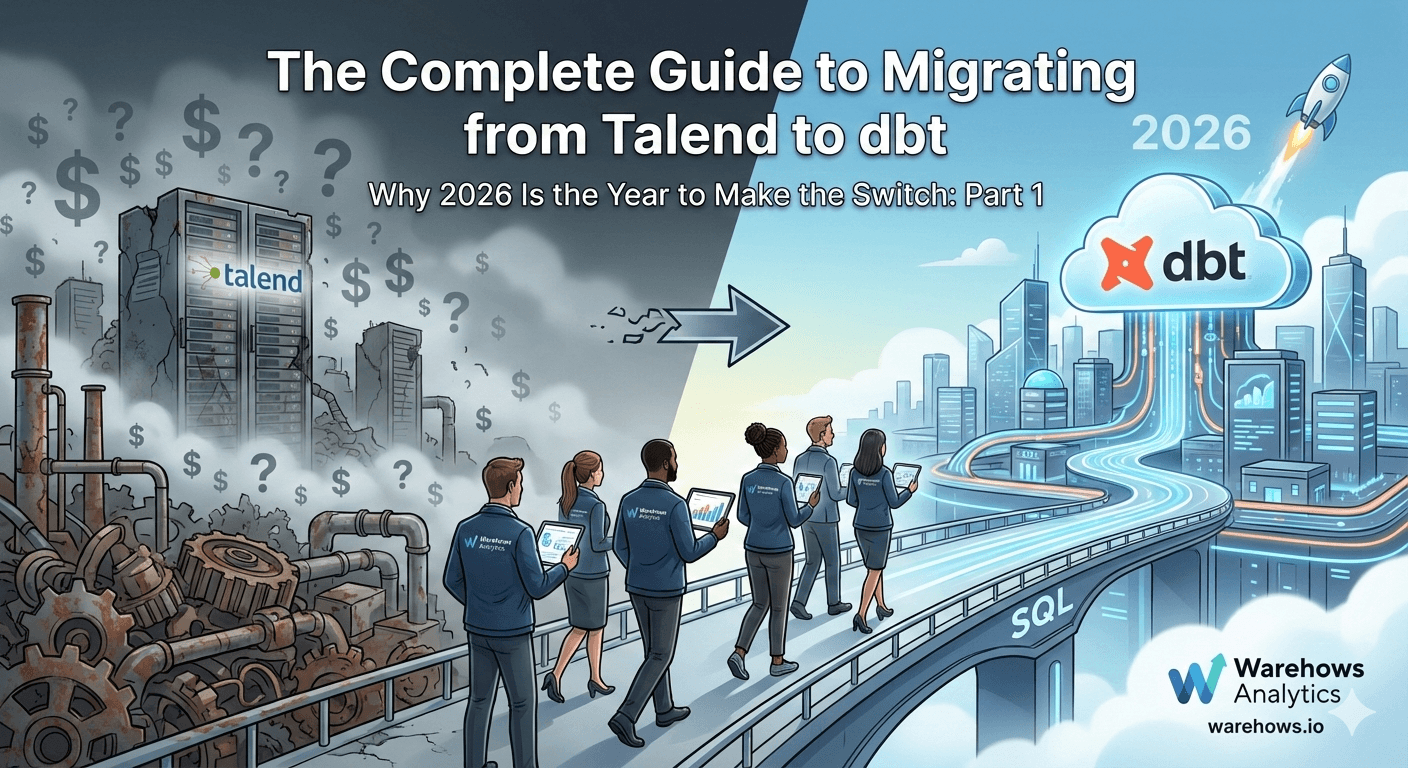
The data engineering landscape is undergoing a seismic shift. If you're running Talend pipelines today, you've likely noticed the tremors—rising licensing costs, complex maintenance overhead, and an architecture that feels increasingly out of step with modern cloud data platforms.
You're not alone. Our team at Warehows Analytics has spent years working with Talend implementations, and we're now helping organizations make the transition to dbt. This guide shares everything we've learned about why, when, and how to migrate from Talend to dbt.
Why Companies Are Leaving Talend in 2025
The Qlik Acquisition Changed Everything
In May 2023, Qlik completed its acquisition of Talend. Both companies share the same private equity owner—Thoma Bravo—which acquired Qlik for $3 billion in 2016 and Talend for $2.4 billion in 2021.
What does this mean for Talend customers?
Pricing uncertainty is the biggest concern. Industry analysts at NPI Financial warned that the speedy acquisition signals a good chance that pricing will quickly become dynamic and could increase. Private equity firms are motivated to realize returns on their investments, and price increases are a tried-and-true tactic.
The new pricing model confirms these fears. In July 2024, Qlik launched Qlik Talend Cloud with a usage capacity-based pricing model. While usage-based pricing sounds fair in theory, many organizations report it makes budgeting unpredictable—especially as data volumes grow.
Talend Open Studio is gone. Qlik discontinued the free, open-source Talend Open Studio in 2024, eliminating the entry point many teams used to get started with the platform.
The Real Pain Points Driving Migration
Beyond the acquisition, organizations are hitting fundamental limitations with Talend's architecture:
Licensing costs that scale painfully. Enterprise Talend deployments can reach €1 million or more annually. When AstraZeneca migrated to dbt, they reduced their ETL licensing costs from €1 million annually to €200,000—an 80% reduction that freed up budget for strategic initiatives.
Cloud pricing that doesn't add up. Talend's cloud solutions cost approximately three times what on-premise deployments cost, yet they retain the same legacy processes that make on-premise systems unwieldy. You're paying more for the same architectural limitations.
Operational burden that never ends. Data teams shouldn't be getting calls in the middle of the night because pipelines have failed. Legacy ETL systems require manual intervention for most problems, inflating operational expenses and distracting teams from value-adding work.
The tMap spaghetti problem. Anyone who's worked with Talend knows this pain. Too many lookup inputs in a tMap, coming in from all directions, can make a Talend job look like something pulled from a shower drain—and just as pleasant to maintain. Our team has inherited Talend projects where understanding a single job required days of archaeology.
No path to AI readiness. This is the strategic issue that matters most in 2025. Legacy ETL systems were built for structured data. Today's AI applications increasingly rely on unstructured data—video, images, audio, and text. Your Talend infrastructure simply wasn't designed to handle this shift. As dbt Labs research shows, 90% of enterprise data still sits trapped in on-premise legacy systems, unable to feed modern AI initiatives.
Why dbt Is the Modern Alternative
dbt (data build tool) represents a fundamentally different approach to data transformation. Rather than moving data through external processing engines, dbt pushes transformations down to your cloud data warehouse—Snowflake, BigQuery, Databricks, or Redshift—where the data already lives.
The Core Advantages
Cloud-native architecture. dbt leverages your warehouse's processing power directly. No separate infrastructure to maintain. No data movement between systems. Your warehouse handles the compute, and you pay only for what you use.
SQL-first philosophy. If your team knows SQL, they know 90% of what they need for dbt. The remaining 10%—Jinja templating for dynamic queries and reusable macros—extends SQL's capabilities without requiring a completely new skillset.
Software engineering practices built in. Version control through Git isn't an afterthought—it's core to how dbt works. Every model change is tracked, reviewable, and reversible. Multiple engineers can work on different models simultaneously without stepping on each other's work.
Testing as a first-class citizen. dbt's testing framework lets you define expectations for your data: uniqueness constraints, null checks, referential integrity, accepted values. Tests run automatically, catching data quality issues before they reach downstream consumers.
Documentation that stays current. dbt generates documentation directly from your models and their relationships. Because the documentation lives alongside the code, it actually stays up to date—unlike the separate documentation systems that inevitably drift from reality.
The Business Case in Numbers
The ROI from migrating to dbt is substantial and measurable:
Company | Result |
|---|---|
AstraZeneca | 80% reduction in licensing costs (€1M → €200K annually), projected $40M TCO savings |
Roche | 70% cost reduction by consolidating Informatica, Talend, and Microsoft tools |
J&J MedTech | Onboarding time reduced from 1 week to 10 minutes |
Macif (French insurer) | Pipeline runtime reduced from 2+ hours to under 5 minutes |
Global travel company | 50% faster delivery, 90% reduction in errors |
These aren't cherry-picked examples. They represent the consistent pattern we see: organizations that migrate from legacy ETL to dbt achieve 50-80% cost reductions while simultaneously improving development velocity and data quality.
The Migration Framework: A Phased Approach
At Warehows Analytics, we've developed a structured approach to Talend-to-dbt migration based on our team's extensive experience with both platforms. Here's the framework that minimizes risk while maximizing value.
Phase 1: Discovery and Assessment
Before writing a single line of dbt code, you need a complete picture of your current state.
Inventory your Talend jobs. Document every job, focusing on:
Components used (tMap, tFlowToIterate, tDBInput, etc.)
Data sources and destinations
Scheduling dependencies
Business criticality
Identify migration candidates. Not every Talend job should become a dbt model. Categorize your jobs:
Convert: SQL-based transformations that map directly to dbt models
Redesign: Complex logic that needs rethinking for ELT patterns
Retire: Redundant or unused jobs that can be eliminated
Keep: Jobs that genuinely require Talend's capabilities (rare, but they exist)
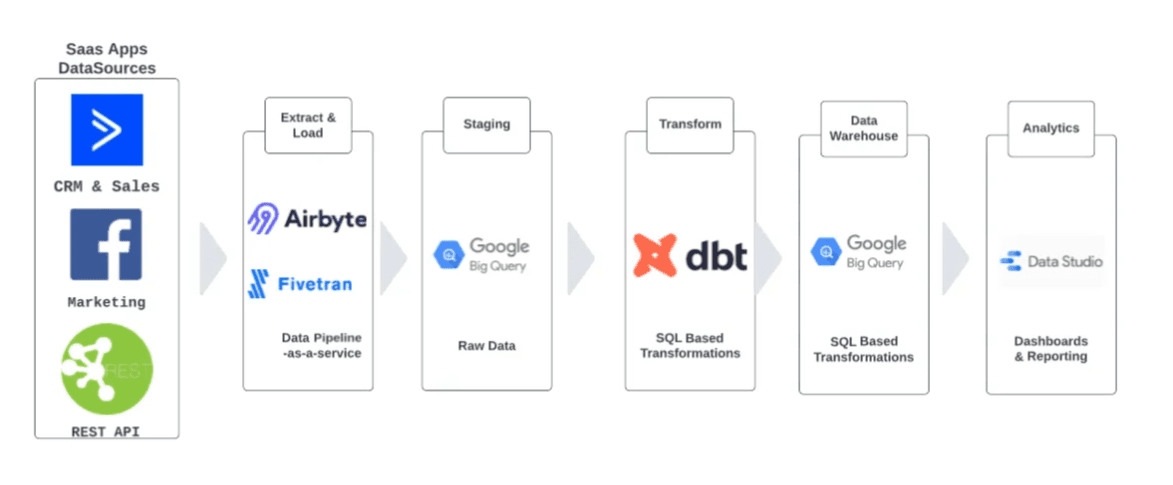
Assess your data warehouse readiness. dbt requires a cloud data warehouse. If you're still running transformations against on-premise databases, you'll need to address data loading first. Tools like Fivetran, Airbyte, or Stitch handle the E and L; dbt handles the T.
Phase 2: Foundation Setup
Configure your dbt project structure. A well-organized project makes everything easier:
Set up profiles.yml. This configures dbt's connection to your data warehouse, replacing Talend's tDBConnection configurations.
Establish version control. Create a Git repository for your dbt project. Define branching strategies, pull request requirements, and CI/CD pipelines from the start.
Read the next part here
the-complete-guide-to-migrating-from-talend-to-dbt-why-2026-is-the-year-to-make-the-switch-part-2
Ready to explore migration? Contact us at pranit@warehows.io to schedule a discovery call. We'll assess your current Talend environment and provide an honest evaluation of whether migration makes sense for your situation.


Reviews
"Team warehows efficiently set up our pipelines on Databricks, integrated tools like Airbyte and BigQuery, and managed LLM and AI tasks smoothly."

Olivier Ramier
CTO, Telescope AI